The word data is most often used as a singular collective mass noun in educated everyday usage. However, due to the history and etymology of the word, considerable controversy has existed on whether it should be considered a mass noun used with verbs conjugated in the singular, or should be treated as the plural of the now-rarely-used datum. == Usage in English == In one sense, data is the plural form of datum. Datum actually can also be a count noun with the plural datums (see usage in datum article) that can be used with cardinal numbers (e.g., "80 datums"); data (originally a Latin plural) is not used like a normal count noun with cardinal numbers and can be plural with plural determiners such as these and many, or it can be used as a mass noun with a verb in the singular form. Even when a very small quantity of data is referenced (one number, for example), the phrase piece of data is often used, as opposed to datum. The debate over appropriate usage continues, but "data" as a singular form is far more common. In English, the word datum is still used in the general sense of "an item given". In cartography, geography, nuclear magnetic resonance and technical drawing, it is often used to refer to a single specific reference datum from which distances to all other data are measured. Any measurement or result is a datum, though data point is now far more common. Data is indeed most often used as a singular mass noun in educated everyday usage. Some major newspapers, such as The New York Times, use it either in the singular or plural. In The New York Times, the phrases "the survey data are still being analyzed" and "the first year for which data is available" have appeared within one day. The Wall Street Journal explicitly allows this usage in its style guide. The Associated Press style guide classifies data as a collective noun that takes the singular when treated as a unit but the plural when referring to individual items (e.g., "The data is sound" and "The data have been carefully collected"). In scientific writing, data is often treated as a plural, as in These data do not support the conclusions, but the word is also used as a singular mass entity like information (e.g., in computing and related disciplines). British usage now widely accepts treating data as singular in standard English, including everyday newspaper usage at least in non-scientific use. UK scientific publishing still prefers treating it as a plural. Some UK university style guides recommend using data for both singular and plural use, and others recommend treating it only as a singular in connection with computers. The IEEE Computer Society allows usage of data as either a mass noun or plural based on author preference, while IEEE in the editorial style manual indicates to always use the plural form. Some professional organizations and style guides require that authors treat data as a plural noun. For example, the Air Force Flight Test Center once stated that the word data is always plural, never singular.
Automated restaurant
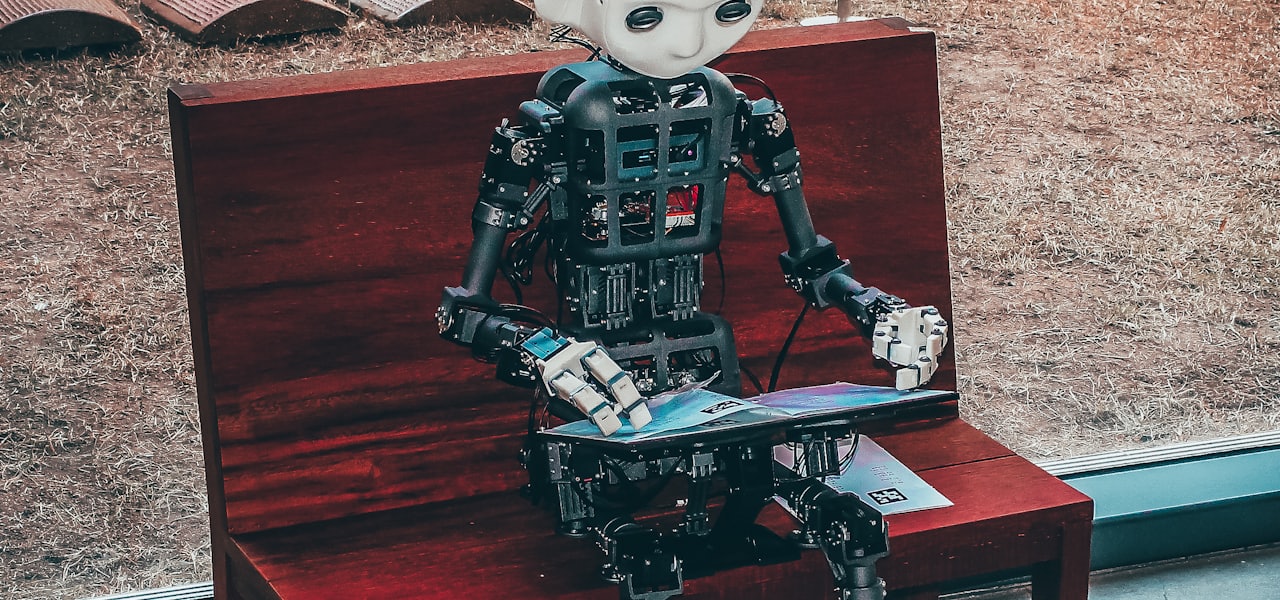
An automated restaurant or robotic restaurant is a restaurant that uses robots to do tasks such as delivering food and drink to the tables or cooking the food. Restaurant automation means the use of a restaurant management system to automate some or occasionally all of the major operations of a restaurant establishment. More recently, restaurants are opening that have completely or partially automated their services. These may include: taking orders, preparing food, serving, and billing. A few fully automated restaurants operate without any human intervention whatsoever. Robots are designed to help and sometimes replace human labour (such as waiters and chefs). The automation of restaurants may also allow for the option for greater customization of an order. == History == === Vending machines === In the late 19th and early 20th century a number of restaurants served food solely through vending machines. These restaurants were called automats or, in Japan, shokkenki. Customers ordered their food directly through the machines. === Sushi conveyors === Yoshiaki Shiraishi is a Japanese innovator who is known for the creation of conveyor belt sushi. He had the idea following difficulty staffing his small sushi restaurant and managing the restaurant on his own. He was inspired seeing beer bottles on a conveyor belt in an Asahi brewery. Yoshiaki's restaurants are an early example of restaurant automation; they used a conveyor belt to distribute dishes around the restaurant, eliminating the need for waiters. This example of automation dates back to the Japanese economic miracle; the first of Yoshiaki's conveyor belt sushi restaurants was opened under the name Mawaru Genroku Sushi in 1958, in Osaka. === Partial automation === As of 2011, across Europe, McDonald's had already begun implementing 7,000 touch screen kiosks that could handle cashiering duties. From 2015 to 2020, Zume had an automated pizza parlor. Later companies would try to produce smaller, less ambitious devices, with one robotics company producing a machine that could automate the slowest and most repetitive parts of assembling a pizza, such as spreading pizza sauce or placing slices of pepperoni, while leaving other customizations to employees. In 2020, a restaurant in the Netherlands began trialling the use of a robot to serve guests. In September 2021, Karakuri's 'Semblr' food service robot served personalised lunches for the 4,000 employees of grocery technology solutions provider ocado Group's head offices in Hatfield, UK. 2,700 different combinations of dishes were on offer. Customers could specify in grams what hot and cold items, proteins, sauces and fresh toppings they wanted. In 2021, Columbia University School of Engineering and Applied Science engineers developed a method of cooking 3D printed chicken with software-controlled robotic lasers. The “Digital Food” team exposed raw 3D printed chicken structures to both blue and infrared light. They then assessed the cooking depth, colour development, moisture retention and flavour differences of the laser-cooked 3D printed samples in comparison to stove-cooked meat. In June 2022 a California nonprofit chain of residential communities, Front Porch, experimented with robots in dining rooms at two locations to supplement wait staff by carrying plated food and drink to tables, and removing dishes. 65% of residents found the robots helpful, with 51% saying they let the staff spend more quality time with diners. 51% of staff were "excited" and 58% said they enabled more quality time with diners. The chain has 19 senior living communities (and 35 affordable housing communities), so it has potential to expand robots to more dining rooms. It is shifting to memory care, which may affect plans. == Rationales == === Advantages === Efficiency: Automated restaurants can significantly enhance operational efficiency by minimizing human error and reducing service time. With automated ordering, payment, and food preparation systems, customers can enjoy faster service and reduced waiting times. Cost savings: By reducing the need for human staff, automated restaurants can potentially lower labor costs. This can be particularly beneficial in areas with high labor expenses, as it allows for better resource allocation and cost management. Consistency: Automation ensures consistency in food quality and presentation. With precise portion control and standardized cooking methods, customers can expect the same quality and taste in their meals every time they visit. Enhanced customer experience: Self-service kiosks and automated systems provide customers with control and convenience. They can customize their orders, browse through menu options, and pay seamlessly, creating a more interactive and satisfying dining experience. === Disadvantages === Lack of personal touch: Automated restaurants may lack the personal interaction and warmth that traditional restaurants provide. Some customers prefer the human touch, personalized recommendations, and the social aspect of dining out. Technical issues: Reliance on technology means that technical glitches and malfunctions can occur, resulting in service disruptions or delays. Maintenance and technical support become critical in ensuring smooth operations. Limited menu complexity: The automation process may be better suited for standardized menu items rather than complex or customized dishes. The ability to cater to unique dietary preferences or accommodate special requests may be limited. Employment implications: Automated restaurants may result in job losses for traditional restaurant staff, potentially impacting the local workforce. It is important to consider the social and economic implications of adopting such technology. == Locations == Automated restaurants have been opening in many countries. Examples include: Nala Restaurant in Naperville, Illinois Fritz's Railroad Restaurant in Kansas City, Kansas Výtopna, a Railway Restaurant using model trains: franchise of various restaurants and coffeehouses in the Czech Republic Bagger's Restaurant in Nuremberg, Germany FuA-Men Restaurant, a ramen restaurant located in Nagoya, Japan Fōster Nutrition in Buenos Aires, Argentina Dalu Robot Restaurant in Jinan, China Haohai Robot Restaurant in Harbin, China Robot Kitchen Restaurant in Hong Kong Robo-Chef restaurant in Tehran, Iran, started in 2017, is the first robotic and "waiterless" restaurant of the Middle East. MIT graduates opened Spyce Kitchens in downtown Boston, Massachusetts, in 2018 Foodom, under Country Garden Holdings, opened January 12, 2020, in Guangzhou, China Robot Chacha, the first robot restaurant of India, is planning to open in the capital city of New Delhi. Kura Revolving Sushi Bar, with a number of locations in the United States, uses a tablets at tables for ordering, a conveyor belt to deliver food, and robots to deliver drinks and condiments. Chipotle Mexican Grill is beginning to deploy the Hyphen Makeline, which assembles up to 350 bowls and salads automatically per hour, and Chippy, an automatic tortilla chip fryer made by Miso Robotics. Serious Dumplings in Boca Raton, Florida
Best AI Photo Editors in 2026
Shopping for the best AI photo editor? An AI photo editor is software that uses machine learning to help you get more done — it keeps getting smarter as the underlying models improve. Pricing, accuracy, and the size of the model behind the tool are the three factors that most affect daily usefulness. Whether you are a beginner or a pro, the right AI photo editor slots into your workflow and pays for itself fast. We tested the leading options and ranked them by quality, value, and ease of use.
How to Choose an AI Paraphrasing Tool
Looking for the best AI paraphrasing tool? An AI paraphrasing tool is software that uses machine learning to help you get more done — it can save you hours every week by automating repetitive work. Most options offer a generous free tier, with paid plans unlocking higher limits, faster processing, and team features. Whether you are a beginner or a pro, the right AI paraphrasing tool slots into your workflow and pays for itself fast. This guide breaks down the top picks, their pros and cons, and who each one is best for.
Tree transducer
In theoretical computer science and formal language theory, a tree transducer (TT) is an abstract machine taking as input a tree, and generating output – generally other trees, but models producing words or other structures exist. Roughly speaking, tree transducers extend tree automata in the same way that word transducers extend word automata. Manipulating tree structures instead of words enable TT to model syntax-directed transformations of formal or natural languages. However, TT are not as well-behaved as their word counterparts in terms of algorithmic complexity, closure properties, etcetera. In particular, most of the main classes are not closed under composition. The main classes of tree transducers are: == Top-Down Tree Transducers (TOP) == A TOP T is a tuple (Q, Σ, Γ, I, δ) such that: Q is a finite set, the set of states; Σ is a finite ranked alphabet, called the input alphabet; Γ is a finite ranked alphabet, called the output alphabet; I is a subset of Q, the set of initial states; and δ is a set of rules of the form q ( f ( x 1 , … , x n ) ) → u {\displaystyle q(f(x_{1},\dots ,x_{n}))\to u} , where f is a symbol of Σ, n is the arity of f, q is a state, and u is a tree on Γ and Q × 1.. n {\displaystyle Q\times 1..n} , such pairs being nullary. === Examples of rules and intuitions on semantics === For instance, q ( f ( x 1 , … , x 3 ) ) → g ( a , q ′ ( x 1 ) , h ( q ″ ( x 3 ) ) ) {\displaystyle q(f(x_{1},\dots ,x_{3}))\to g(a,q'(x_{1}),h(q''(x_{3})))} is a rule – one customarily writes q ( x i ) {\displaystyle q(x_{i})} instead of the pair ( q , x i ) {\displaystyle (q,x_{i})} – and its intuitive semantics is that, under the action of q, a tree with f at the root and three children is transformed into g ( a , q ′ ( x 1 ) , h ( q ″ ( x 3 ) ) ) {\displaystyle g(a,q'(x_{1}),h(q''(x_{3})))} where, recursively, q ′ ( x 1 ) {\displaystyle q'(x_{1})} and q ″ ( x 3 ) {\displaystyle q''(x_{3})} are replaced, respectively, with the application of q ′ {\displaystyle q'} on the first child and with the application of q ″ {\displaystyle q''} on the third. === Semantics as term rewriting === The semantics of each state of the transducer T, and of T itself, is a binary relation between input trees (on Σ) and output trees (on Γ). A way of defining the semantics formally is to see δ {\displaystyle \delta } as a term rewriting system, provided that in the right-hand sides the calls are written in the form q ( x i ) {\displaystyle q(x_{i})} , where states q are unary symbols. Then the semantics [ [ q ] ] {\displaystyle [\![q]\!]} of a state q is given by [ [ q ] ] = { u ↦ v ∣ u is a tree on Σ , v is a tree on Γ , and q ( u ) → δ ∗ v } . {\displaystyle [\![q]\!]=\{u\mapsto v\mid u{\text{ is a tree on }}\Sigma ,\ v{\text{ is a tree on }}\Gamma {\text{, and }}q(u)\to _{\delta }^{}v\}.} The semantics of T is then defined as the union of the semantics of its initial states: [ [ T ] ] = ⋃ q ∈ I [ [ q ] ] . {\displaystyle [\![T]\!]=\bigcup _{q\in I}[\![q]\!].} === Determinism and domain === As with tree automata, a TOP is said to be deterministic (abbreviated DTOP) if no two rules of δ share the same left-hand side, and there is at most one initial state. In that case, the semantics of the DTOP is a partial function from input trees (on Σ) to output trees (on Γ), as are the semantics of each of the DTOP's states. The domain of a transducer is the domain of its semantics. Likewise, the image of a transducer is the image of its semantics. === Properties of DTOP === DTOP are not closed under union: this is already the case for deterministic word transducers. The domain of a DTOP is a regular tree language. Furthermore, the domain is recognisable by a deterministic top-down tree automaton (DTTA) of size at most exponential in that of the initial DTOP. That the domain is DTTA-recognizable is not surprising, considering that the left-hand sides of DTOP rules are the same as for DTTA. As for the reason for the exponential explosion in the worst case (that does not exist in the word case), consider the rule q ( f ( x 1 , x 2 ) ) → g ( p 1 ( x 1 ) , p 2 ( x 1 ) , p 3 ( x 2 ) ) {\displaystyle q(f(x_{1},x_{2}))\to g(p_{1}(x_{1}),p_{2}(x_{1}),p_{3}(x_{2}))} . In order for the computation to succeed, it must succeed for both children. That means that the right child must be in the domain of p 3 {\displaystyle p_{3}} . As for the left child, it must be in the domain of both p 1 {\displaystyle p_{1}} and p 2 {\displaystyle p_{2}} . Generally, since subtrees can be copied, a single subtree can be evaluated by multiple states during a run, despite the determinism, and unlike DTTA. Thus the construction of the DTTA recognising the domain of a DTOP must account for sets of states and compute the intersections of their domains, hence the exponential. In the special case of linear DTOP, that is to say DTOP where each x i {\displaystyle x_{i}} appears at most once in the right-hand side of each rule, the construction is linear in time and space. The image of a DTOP is not a regular tree language. Consider the transducer coding the transformation f ( x ) → g ( x , x ) {\displaystyle f(x)\to g(x,x)} ; that is, duplicate the child of the input. This is easily done by a rule q ( f ( x 1 ) ) → g ( p ( x 1 ) , p ( x 1 ) ) {\displaystyle q(f(x_{1}))\to g(p(x_{1}),p(x_{1}))} , where p encodes the identity. Then, absent any restrictions on the first child of the input, the image is a classical non-regular tree language. However, the domain of a DTOP cannot be restricted to a regular tree language. That is to say, given a DTOP T and a language L, one cannot in general build a DTOP T ′ {\displaystyle T'} such that the semantics of T ′ {\displaystyle T'} is that of T, restricted to L. This property is linked to the reason deterministic top-down tree automata are less expressive than bottom-up automata: once you go down a given path, information from other paths is inaccessible. Consider the transducer coding the transformation f ( x , y ) → y {\displaystyle f(x,y)\to y} ; that is, output the right child of the input. This is easily done by a rule q ( f ( x 1 , x 2 ) ) → p ( x 2 ) {\displaystyle q(f(x_{1},x_{2}))\to p(x_{2})} , where p encodes the identity. Now let's say we want to restrict this transducer to the finite (and thus, in particular, regular) domain { f ( c , a ) , f ( c , b ) } {\displaystyle \{f(c,a),\ f(c,b)\}} . We must use the rules q ( f ( x 1 , x 2 ) ) → p ( x 2 ) , p ( a ) → a , p ( b ) → b {\displaystyle q(f(x_{1},x_{2}))\to p(x_{2}),\ p(a)\to a,\ p(b)\to b} . But in the first rule, x 1 {\displaystyle x_{1}} does not appear at all, since nothing is produced from the left child. Thus, it is not possible to test that the left child is c. In contrast, since we produce from the right child, we can test that it is a or b. In general, the criterion is that DTOP cannot test properties of subtrees from which they do not produce output. DTOP are not closed under composition. However this problem can be solved by the addition of a lookahead: a tree automaton, coupled to the transducer, that can perform tests on the domain which the transducer is incapable of. This follows from the point about domain restriction: composing the DTOP encoding identity on { f ( c , a ) , f ( c , b ) } {\displaystyle \{f(c,a),\ f(c,b)\}} with the one encoding f ( x , y ) → y {\displaystyle f(x,y)\to y} must yield a transducer with the semantics { f ( c , a ) ↦ a , f ( c , b ) ↦ b } {\displaystyle \{f(c,a)\mapsto a,\ f(c,b)\mapsto b\}} , which we know is not expressible by a DTOP. The typechecking problem—testing whether the image of a regular tree language is included in another regular tree language—is decidable. The equivalence problem—testing whether two DTOP define the same functions—is decidable. == Bottom-Up Tree Transducers (BOT) == As in the simpler case of tree automata, bottom-up tree transducers are defined similarly to their top-down counterparts, but proceed from the leaves of the tree to the root, instead of from the root to the leaves. Thus the main difference is in the form of the rules, which are of the form f ( q 1 ( x 1 ) , … , q n ( x n ) ) → q ( u ) {\displaystyle f(q_{1}(x_{1}),\dots ,q_{n}(x_{n}))\to q(u)} .
Picture Prowler
Picture Prowler was an early piece of photo management software developed around and meant to show off Xing Technology's JPEG image decompression library during the early 1990s. Little known today, it featured thumbnail based picture management, printing, etc. The primary developer was Ray Bunnage from compression / decompression libraries developed by Howard Gordon and Chris Eddy.
Ocrad
Ocrad is an optical character recognition program and part of the GNU Project. It is free software licensed under the GNU GPL. Based on a feature extraction method, it reads images in portable pixmap formats known as Portable anymap and produces text in byte (8-bit) or UTF-8 formats. Also included is a layout analyser, able to separate the columns or blocks of text normally found on printed pages. == User interface == Ocrad can be used as a stand-alone command-line application or as a back-end to other programs. Kooka, which was the KDE environment's default scanning application until KDE 4, can use Ocrad as its OCR engine. Since conversion to newer Qt versions, current versions of KDE no longer contain Kooka; development continues in the KDE git repository. Ocrad can be also used as an OCR engine in OCRFeeder. == History == Ocrad has been developed by Antonio Diaz Diaz since 2003. Version 0.7 was released in February 2004, 0.14 in February 2006 and 0.18 in May 2009. It is written in C++. Archives of the bug-ocrad mailing list go back to October 2003.